AI · Field Notes
He Couldn't Imagine What Else It Was For
I got talking to a teacher after Norway lost to England at the World Cup. He'd tried the AI his school gave him on exactly one task. The problem wasn't the tool. It was that he couldn't picture a second use for it.
I got talking to a teacher after Norway lost to England - the loose, consoling kind of conversation you fall into with a stranger when you've both just watched the same game slip away in extra time. He asked what I actually do all day. I tried to describe what it's like to have AI build things for me, all day, every day. Then he told me his side, and it stuck with me for days.
His school had handed the teachers Copilot - Microsoft's AI assistant, bolted into the Office apps they already use. No training, no time, a tight budget on how much they're allowed to run it. He'd given it a go. He found it OK. I've used it too, and next to a frontier model it's a pale copy - but that's not the part that stayed with me.
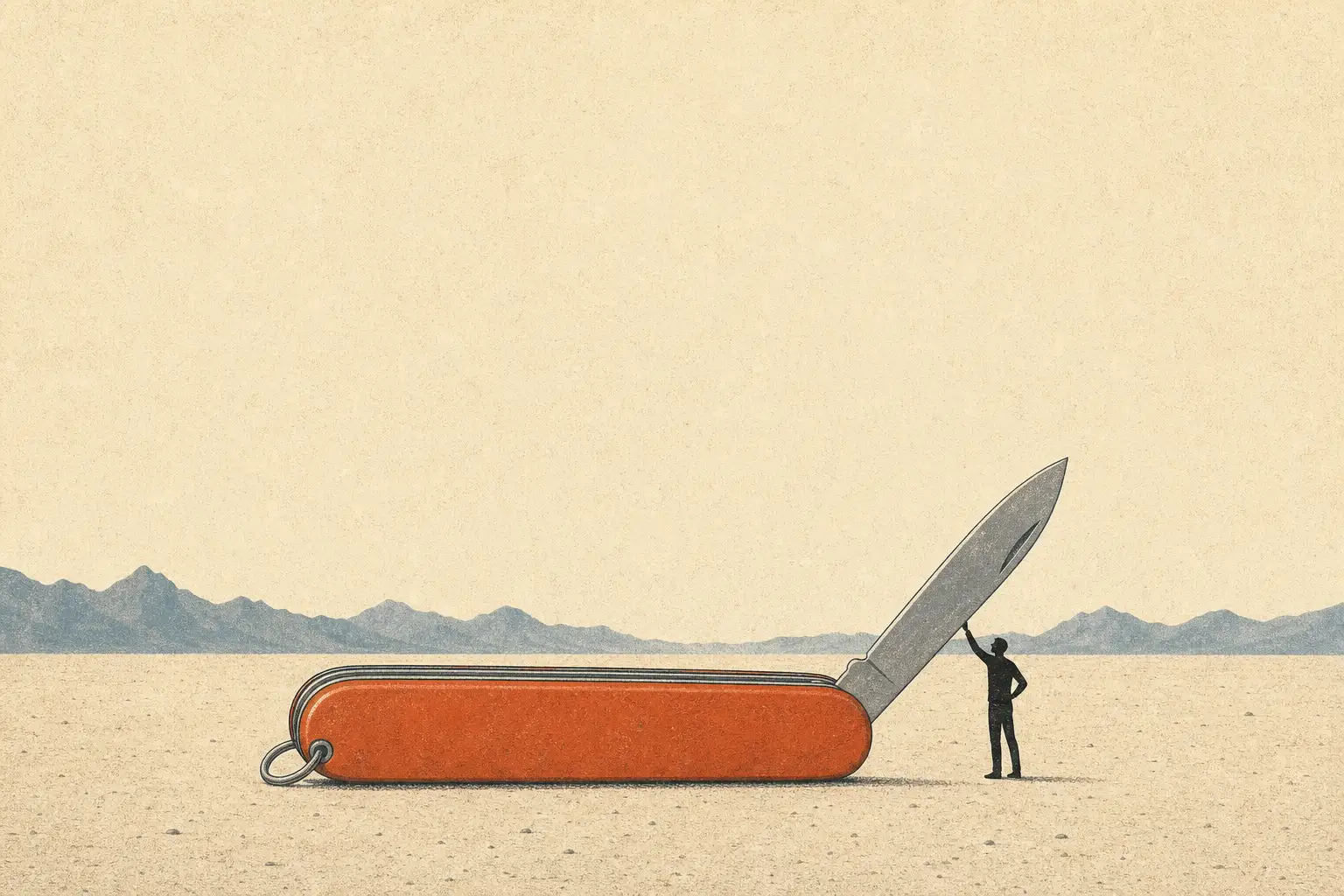
Because he'd found exactly one thing to do with it: grading papers. He fed it student work, it marked them, and by his account the results were good - close enough to trust. Fine. Useful. But when I asked what else he might use it for, he came up empty. Not dismissive - blank. He couldn't picture a second use. One task worked, and the horizon ended right there.
That's the part worth sitting with, because it's the real signature of a paradigm shift - a moment when the ground rules change, not just the tools. The tool is already in the room. What's missing is the imagination to see what it's for. He was short on neither curiosity nor brains. He was short on examples. Nothing in his world had shown him the thing could be anything other than a faster red pen.
We've all been him. When Google arrived, people used it as an electronic phone book - look up a number, close the tab - because that was the only use anyone could picture. It took years to imagine that instant, universal search would reshape what we bothered to remember, how we settled arguments, what a question even was. I watched the internet arrive exactly like that. The tool lands early. The imagination catches up slowly, one borrowed example at a time.
The hard part of a paradigm shift isn't getting the tool. It's imagining what it's for.
I have the opposite problem, and it isn't because I'm smarter. I've spent a year letting this thing stretch what I think to ask of it, until now I can't stop finding uses - it builds my apps, runs my errands, drafts these posts. He got a licence and a login. The distance between us isn't intelligence or access. It's a year of examples, and nobody has handed him theirs.